 Precision Milling Cutters,Cutting Tools for CNC Machining Every Material

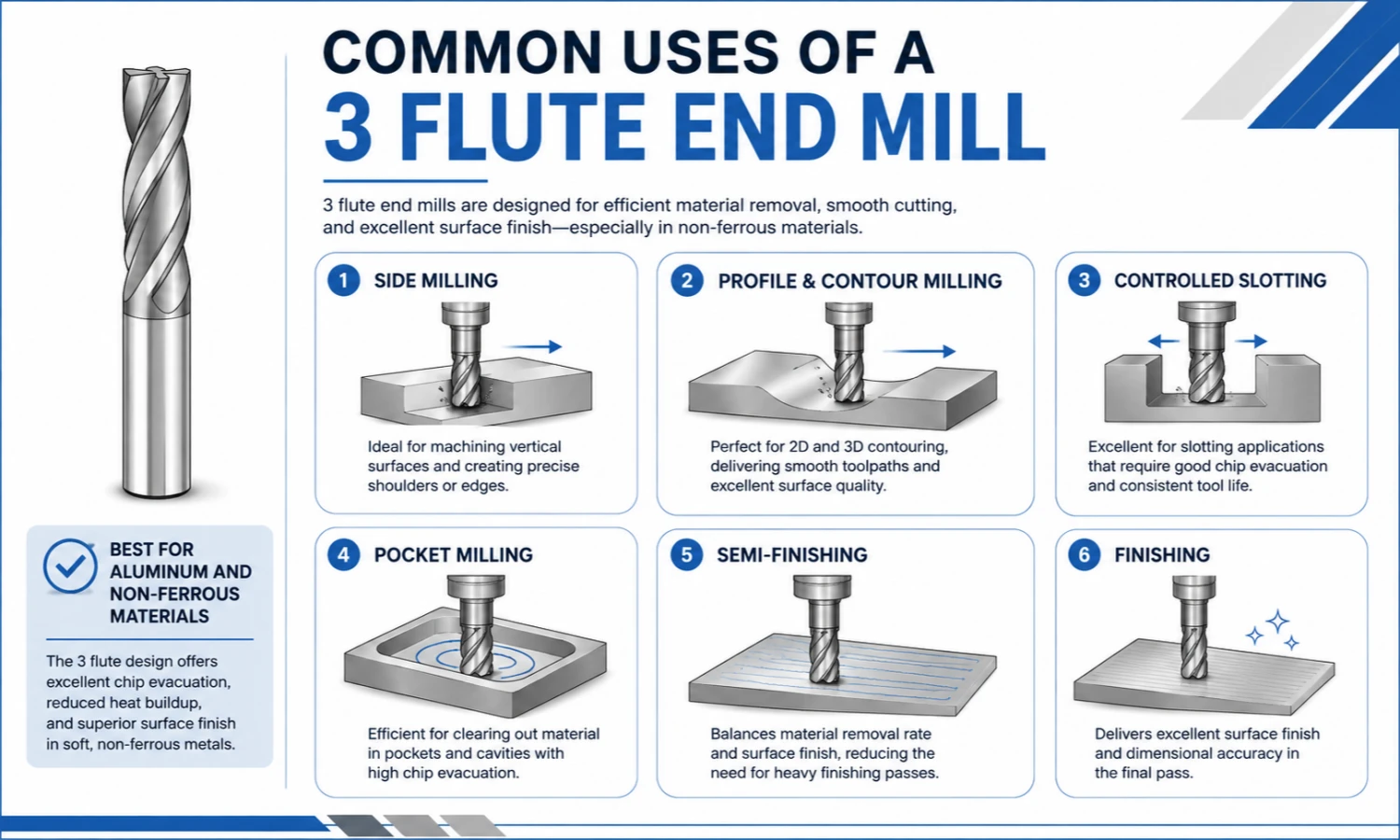
A 3 flute end mill is mainly used for aluminum machining, side milling, profile milling, controlled slotting, pocket milling, semi-finishing, and finishing. Its three cutting edges provide a practical balance between chip space, cutter rigidity, and surface quality.
Compared with a 2 flute cutter, the third cutting edge increases tool engagement and supports more stable side milling. At the same time, a three-flute design normally retains more chip space than many higher-flute tools.
This balance makes the cutter useful for aluminum parts that require clean walls and controlled chip removal. However, the correct choice still depends on the operation, cutting depth, tool reach, machine setup, and coolant method.
Quick Answer: Common Uses of a 3 Flute End Mill
Typical applications include:
- Aluminum and aluminum-alloy machining
- Side milling
- Profile and contour milling
- Controlled slotting
- Pocket milling
- Step and shoulder milling
- Semi-finishing
- Finishing
A three-flute cutter works best when the machining process needs both chip evacuation and stable cutting. It is especially useful for profiling and finishing operations where wall quality matters.
For deep full-width slots or heavy roughing, a 2 flute tool may work better because it offers larger flute spaces.
Why Three Flutes Work Well in Aluminum
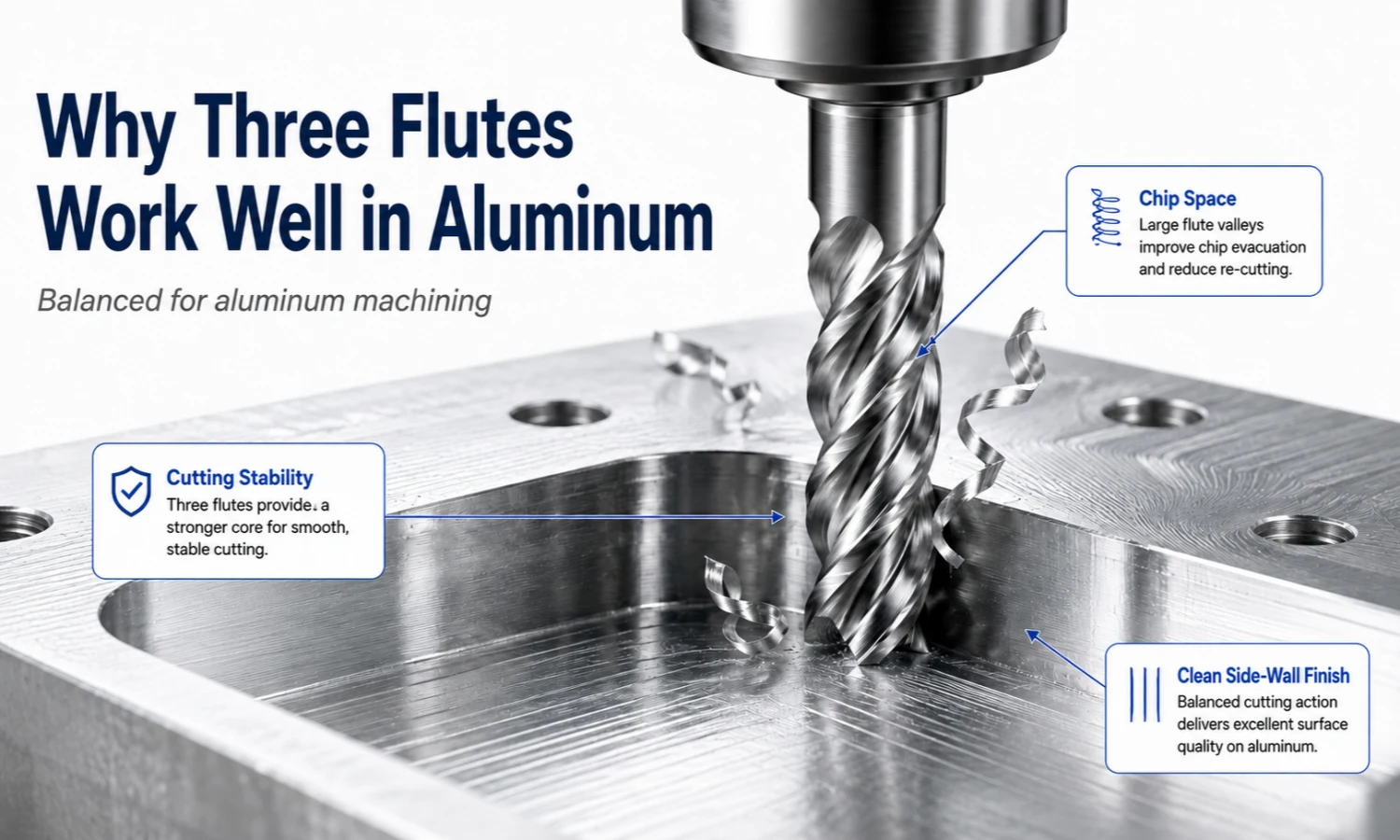
Flute Space Helps Control Aluminum Chips
Aluminum often produces large or continuous chips. If these chips remain inside the cutting area, they may be recut, collect in the flutes, or stick to the cutting edge.
A three-flute cutter keeps useful chip space while adding another cutting edge. Therefore, it can remove aluminum efficiently when the toolpath, coolant, air blast, speed, and feed support smooth chip evacuation.
The cutter does not solve poor chip control by itself. Deep engagement, excessive tool load, or weak coolant delivery can still cause chip packing.
A Stronger Core Supports Cutting Stability
In comparable cutter designs, adding a third flute usually increases the core section compared with a two-flute tool. A stronger core can reduce tool deflection and support more stable engagement.
This matters during side milling, profiling, and finishing. Less deflection can help maintain wall geometry and produce a more consistent surface.
However, tool length also matters. A long flute length or excessive overhang can reduce rigidity even when the cutter has a strong core.
More Cutting-Edge Engagement Can Improve Finish
The additional cutting edge increases the number of cutting engagements per tool revolution. As a result, the tool can support a smoother and more consistent finish under suitable conditions.
Runout, holder condition, feed per tooth, edge geometry, and machine rigidity still affect the final result. Flute count is important, but it is only one part of the cutting system.
Main 3 Flute End Mill Applications
Side Milling and Profiling
Side milling and profile milling are common uses of a three-flute cutter. These operations need stable contact, accurate wall geometry, and controlled chip removal.
The third cutting edge supports regular engagement with the workpiece. Meanwhile, the flute spaces leave room for aluminum chips.
This combination suits straight walls, external profiles, internal contours, and component edges.
Controlled Slotting
A 3 flute end mill can machine slots when the slot depth and chip-control conditions are suitable.
For shallow or controlled slotting, it provides a good balance between material removal and stability. However, full-width slotting places all three cutting edges in contact with the material and leaves less room for chips.
If chips begin to collect inside a deep slot, reduce the cutting load, improve coolant or air delivery, or move to a 2 flute cutter.
Pocket Milling
Pocket milling requires both stable cutting and an effective toolpath. The cutter must remove material while allowing chips to leave the pocket.
A ramping entry, helical entry, or adaptive toolpath can reduce chip recutting. By contrast, aggressive full-width engagement may overload the cutter or trap chips.
Toolpath design therefore matters as much as flute count.
Semi-Finishing and Finishing
Three-flute cutters also work well for semi-finishing and finishing aluminum parts.
The additional cutting edge can support cleaner walls and a more uniform surface than some two-flute tools. Therefore, this flute count is useful when surface quality matters more than maximum chip volume.
What Materials Can a 3 Flute End Mill Cut?
Aluminum and Aluminum Alloys
Aluminum is the main application for many three-flute tools. The design combines chip space with the rigidity needed for side milling, profiling, pocketing, and finishing.
Before selecting the cutter, review the aluminum grade, operation, cutting depth, chip form, coolant method, and finish requirement.
Copper and Brass
A three-flute carbide cutter can also machine copper and brass when its edge geometry and cutting conditions suit the material.
Sharp cutting edges and good chip control help reduce burrs and maintain surface quality. However, copper and brass do not behave exactly like aluminum, so one tool design may not suit every grade.
Plastics and Other Non-Ferrous Materials
Some plastics and other non-ferrous materials can also be machined with a three-flute tool.
For plastics, heat buildup and chip melting may become important. Therefore, use a tool geometry and coolant method that keep the cutting zone clear.
Composite Materials
A three-flute cutter may suit selected composites, but composite structures vary widely. Fiber direction, resin content, edge quality, and delamination risk can change the required geometry.
For composite applications, confirm the material structure and cutting goal before choosing the tool.
Common Problems and Practical Checks
| Machining Problem | Practical Check |
|---|---|
| Chips collect inside a slot | Reduce engagement, improve coolant or air blast, or consider a 2 flute cutter |
| Aluminum sticks to the edge | Check chip evacuation, lubrication, edge geometry, and surface treatment |
| Side walls look rough | Check runout, tool overhang, holder condition, feed, and radial engagement |
| Chatter or vibration occurs | Shorten tool reach, improve clamping, and reduce unstable engagement |
| Tool life is inconsistent | Review runout, chip recutting, cutting load, coolant, and tool selection |
| Burrs remain on the part | Check edge sharpness, tool wear, cutting direction, and finishing parameters |
These symptoms do not always come from flute count. For example, changing from two flutes to three flutes will not correct excessive runout or a weak tool holder.
Start by checking the complete setup. Then adjust the flute count if chip space, rigidity, or cutting-edge engagement remains the main problem.
When Is a 3 Flute End Mill a Good Choice?
Choose a three-flute cutter when:
- The workpiece is aluminum or another suitable non-ferrous material
- The operation includes side milling or profiling
- Wall quality is important
- Semi-finishing or finishing is required
- A 2 flute tool does not provide enough stability
- A higher-flute tool leaves insufficient chip space
- The toolpath and coolant method can control chip evacuation
The cutter is not automatically the best option for every aluminum job. Cutting depth, radial engagement, tool reach, machine rigidity, and chip form should guide the final decision.
When Should You Choose Another Flute Count?
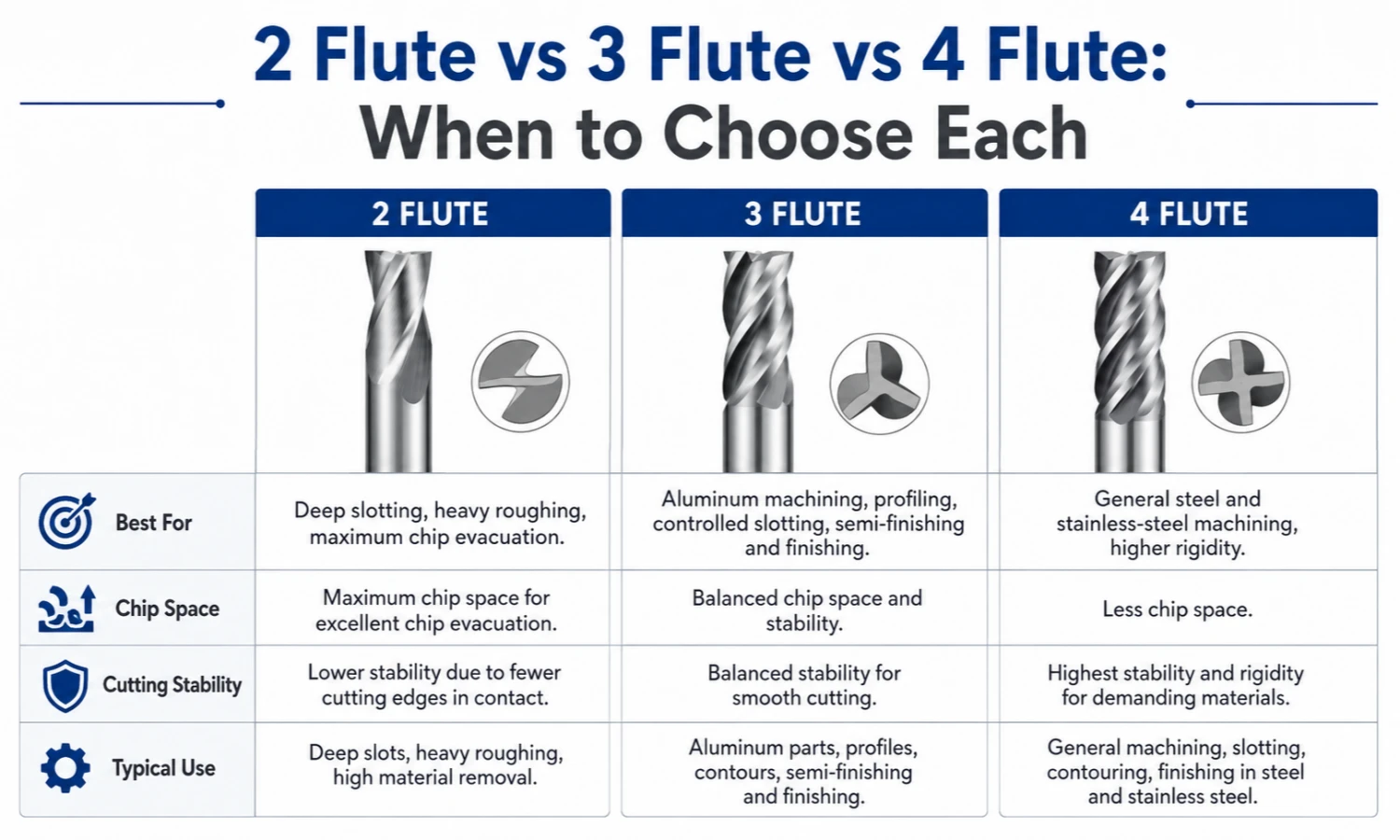
Different flute counts suit different materials, chip-control needs, and machining operations. The following comparison provides a quick selection reference.
Choose 2 Flutes for Deep Slotting and Heavy Roughing
A 2 flute cutter provides larger flute spaces. It is often the better choice for:
- Deep full-width slotting
- Heavy aluminum roughing
- Large chip loads
- Operations where maximum chip evacuation is the main concern
A three-flute cutter becomes more attractive when wall quality and cutting stability matter more.
For a detailed comparison, read our 2 flute vs 3 flute end mill for aluminum guide.
You can also view our 2 Flute End Mill for deep slotting and aluminum roughing.
Consider 4 Flutes for Steel and Stainless Steel
A 4 flute cutter provides more cutting edges and often has a stronger core than a lower-flute tool. It is commonly selected for general steel and stainless-steel machining, where chip volume may be lower and rigidity is important.
However, four flutes are not automatically better. The correct choice depends on the material, chip form, cutting depth, and operation.
For steel and stainless-steel applications, view our 4 Flute End Mills.
How to Select a 3 Flute End Mill
Start with the Workpiece Material
First, identify the material and grade. Aluminum, copper, brass, plastics, and composites produce different chips and cutting temperatures.
The material affects the required edge geometry, surface treatment, and chip-control method.
Match the Tool to the Operation
Next, identify the main operation.
A cutter used for side milling may need a different flute length and edge design from one used for slotting, pocketing, or finishing.
Full-width engagement also creates different chip-control demands from light radial finishing.
Choose Suitable Dimensions and Reach
Important dimensions include:
- Cutting diameter
- Flute length
- Overall length
- Shank diameter
- Neck length, when required
Use the shortest practical flute length and overall length. A shorter setup generally improves rigidity and reduces vibration.
Long-reach tools can access deep or restricted features. However, additional overhang increases deflection risk, so the cutting strategy must match the setup.
Review Edge Geometry and Surface Treatment
Edge geometry and surface treatment should match the material, operation, coolant condition, chip-adhesion risk, and required tool life.
For aluminum, sharp cutting edges and smooth chip flow are especially important. The correct option should be selected for the application rather than chosen only by coating name.
Confirm Starting Parameters for the Actual Tool
A single speed and feed value cannot fit every three-flute cutter.
Tool diameter, flute length, edge design, coating, workpiece grade, machine rigidity, holder, coolant, axial depth, and radial engagement all affect the starting parameters.
Therefore, use parameters supplied for the confirmed tool specification. Begin with a controlled trial, then review chip form, surface finish, spindle load, sound, and cutter wear.
Frequently Asked Questions
What is a 3 flute end mill used for?
It is mainly used for aluminum operations that require controlled chip evacuation, stable cutting, and clean side walls.
It is selected when the operation needs both chip evacuation and stable cutting.
Is a Three-Flute Cutter Suitable for Deep Slotting?
It may work in controlled slots, but it is not normally the first choice for very deep full-width slotting.
Deep slots leave less room for chips to escape. In that situation, a 2 flute cutter, lighter engagement, or a different toolpath may provide better chip control.
Why does aluminum stick to the cutting edge?
Aluminum may stick when chips are not removed quickly, lubrication is insufficient, the cutting edge is worn, or the tool geometry does not suit the material.
Check coolant or air delivery, chip recutting, cutting load, edge condition, and surface treatment.
Can a Three-Flute Cutter Machine Steel?
A three-flute cutter can be designed for selected steel applications. However, many three-flute tools are mainly intended for aluminum and non-ferrous materials.
For general steel and stainless-steel machining, a 4 flute tool may offer a more suitable balance of rigidity and cutting-edge count.
Need a 3 Flute End Mill for Aluminum?
For product specifications, custom dimensions, geometry, coating, marking, and packaging options, view our 3 flute carbide flat end mill for aluminum.
Send the workpiece material, machining operation, required dimensions, quantity, and any available drawing or current cutter information.
Email your drawing, tool photos, or requirements to sales@cutterbest.com.