 Precision Milling Cutters,Cutting Tools for CNC Machining Every Material

What Is the Best End Mill for Stainless Steel?
Choosing the best end mill for stainless steel is not as simple as selecting one flute count, coating, or cutter shape. The right tool depends on the stainless steel grade, machining operation, workpiece geometry, machine rigidity, chip evacuation, tool overhang, and required surface finish.
Many stainless steels, especially common austenitic grades, have relatively low thermal conductivity and a tendency to work harden during machining. Heat and unstable cutting can therefore place additional demands on the cutting edge, coating, tool geometry, and machine setup.
There is no single end mill that is best for every stainless steel application.
For many CNC milling operations, a solid carbide end mill is a common starting point because carbide offers high rigidity, wear resistance, and cutting-edge stability under suitable machining conditions. However, the final cutter still needs to match the actual workpiece and operation.
Quick Stainless Steel End Mill Selection Guide
| Machining Requirement | Tool Type to Consider | Main Selection Concern |
|---|---|---|
| Flat surfaces and side milling | Flat End Mill | Stability, chip control, and edge strength |
| Curved or 3D surfaces | Ball Nose End Mill | Contour accuracy and surface finish |
| Internal or external R-corners | Corner Radius End Mill | Corner strength and reduced edge damage |
| Heavy material removal | Roughing End Mill | Chip evacuation, rigidity, and cutting load |
| General profiling | Solid Carbide End Mill | Flute count, coating, geometry, and stability |
| Higher-performance milling | Variable helix/pitch designs may be considered | Vibration control and machining stability |
Use this table as a starting point rather than a fixed rule. The preferred cutter may change when the stainless steel grade, cutting depth, engagement, machine condition, or workpiece geometry changes.
If you already know your machining requirements and want to review available standard and custom options, see our End Mills for Stainless Steel.
Choose the End Mill Type by Machining Operation
Our factory does not treat stainless steel machining as one fixed cutter application. Flat end mills, ball nose end mills, corner radius end mills, and roughing end mills serve different machining purposes.
Therefore, the machining feature should usually be identified before flute count or coating is selected.
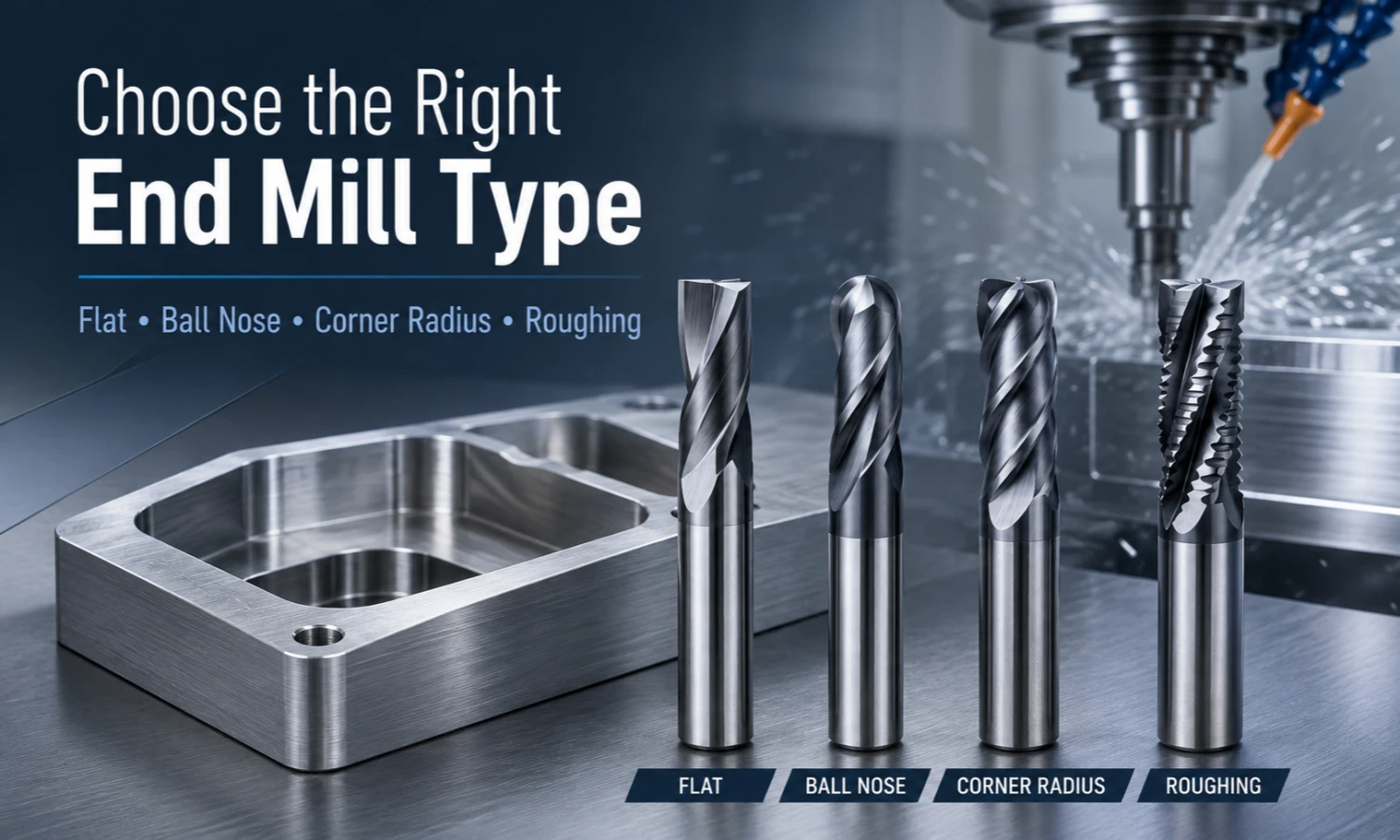
Flat End Mills for Flat Surfaces and Side Milling
A flat end mill is commonly considered for:
- Side milling
- Shoulder milling
- Flat-bottom machining
- Profiling
- Suitable slotting operations
If the workpiece requires straight walls, flat bottoms, or square shoulders, a flat cutting end is generally more appropriate than a ball nose geometry.
For specifications and available options, see our Flat End Mill.
Ball Nose End Mills for Curved and 3D Surfaces
Ball nose end mills are primarily used when the cutter must follow curved or three-dimensional geometry.
Typical applications include molds, curved cavities, 3D profiling, contour finishing, and complex surfaces.
The rounded cutting end follows changing surface angles more naturally than a flat-ended cutter. However, when machining stainless steel, the end shape is only one part of the selection. Tool rigidity, coating, flute design, cutting length, and required finish still need to be considered.
For curved-surface machining options, see our Ball Nose End Mills.
Corner Radius End Mills for R-Corners and Stronger Cutting Edges
A corner radius end mill, also commonly called a bull nose end mill, combines a flat cutting end with a radius at the outer corner.
The radius can strengthen the cutting corner compared with a sharp 90-degree corner. It is also appropriate when the workpiece drawing specifies an internal R-radius.
For demanding stainless steel applications, the actual radius, cutter diameter, cutting load, and machining strategy should be evaluated together.
For radius and custom geometry options, see our Bull Nose End Mill.
Roughing End Mills for Heavy Material Removal
When the main goal is removing larger amounts of material rather than producing the final surface finish, a roughing end mill may be considered.
Roughing cutters focus on material removal, chip formation, cutting-load management, and process stability. The appropriate design still depends on the stainless steel grade, machining allowance, cutter diameter, depth of cut, chip evacuation, and machine rigidity.For heavy material removal applications, see our Roughing End Mills.
Why Solid Carbide Is Commonly Used for Stainless Steel
A carbide end mill for stainless steel is common in modern CNC machining because solid carbide provides properties that are useful under demanding cutting conditions.
Solid carbide can offer:
- High rigidity
- Good wear resistance
- Cutting-edge stability
- Resistance to elevated cutting temperatures
- Compatibility with different cutting geometries and coating systems
These characteristics are useful because stainless steel can generate considerable heat and may work harden when cutting becomes unstable or the edge begins rubbing instead of cutting effectively.
However, selecting solid carbide does not finish the tool-selection process. Cutter diameter, cutting length, flute count, coating, geometry, tool overhang, machine condition, and machining operation still need to be evaluated together.
For available carbide tooling options, see our Carbide End Mill Cutter.
For a broader carbide tool selection process, read How to Choose a Carbide End Mill Cutter.
How to Choose Flute Count: Chip Evacuation vs Rigidity
A common search question is: How many flutes should an end mill have for stainless steel?
There is no universal answer.
Flute count changes both the number of cutting edges and the space available for chips. Lower flute counts generally provide more chip space, while higher flute counts provide more cutting contacts and often use a relatively stronger core.
The correct balance depends on the operation, cutter diameter, engagement, chip volume, machine rigidity, and required finish.
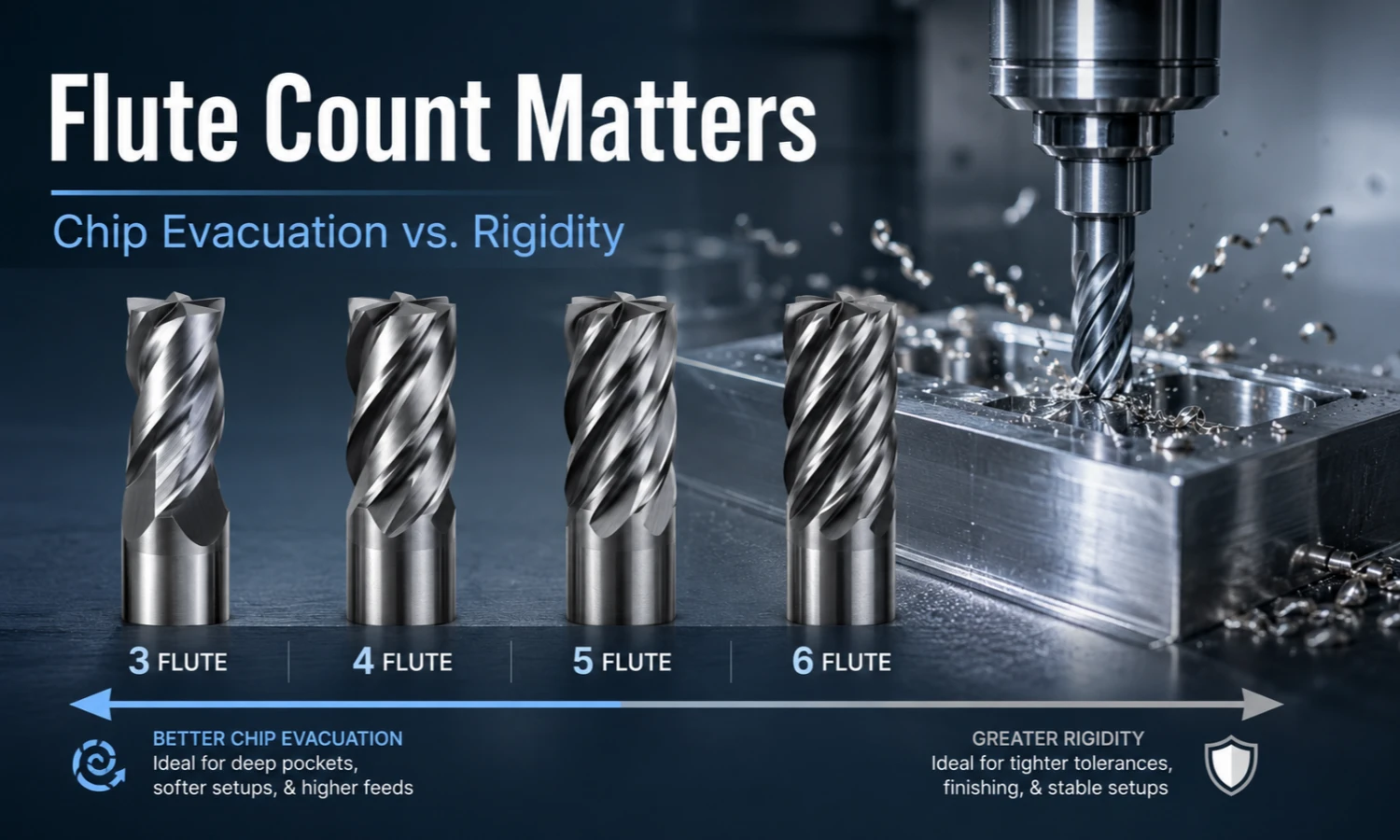
3-Flute End Mills
Three-flute designs provide relatively generous flute space and may be considered when chip evacuation is an important part of the application.
However, flute count alone does not determine performance. Helix geometry, core design, radial engagement, cutting depth, and cutter diameter must also be considered.
4-Flute End Mills
balance between cutting-edge count, core strength, chip space, and general machining versatility.
They may be considered for side milling, profiling, shoulder milling, and other CNC operations when the tool geometry and setup are suitable.
See our 4 Flute End Mill for available specifications and application options.
5-Flute End Mills
Five-flute cutters frequently appear in high-performance stainless steel applications because the additional cutting edge can be useful when engagement is controlled and chip evacuation remains adequate.
However, increasing the flute count also reduces the space available for chips.
Therefore, a 5-flute design should not be selected only because the workpiece is stainless steel. Deep slotting, high chip volume, limited evacuation, cutter diameter, and machine rigidity may change the preferred flute count.
6-Flute End Mills
Six-flute end mills may be considered for stable side milling, profiling, semi-finishing, and finishing applications where chip evacuation is manageable and more cutting contacts are beneficial.
They should not be treated as finishing-only cutters or as the automatic choice for harder materials. The complete cutter design and machining strategy remain important.
For a broader flute-count comparison, read 2 Flute vs 4 Flute vs 6 Flute End Mill.
What Coating Is Suitable for Stainless Steel End Mills?
Coating is another important part of selecting end mills for stainless steel.
Industry tooling for stainless steel commonly uses heat-resistant and wear-resistant coating systems such as:
- AlTiN
- AlCrN
- TiAlN
- TiSiN or TiAlSiN in some higher-performance applications
Depending on the coating system and application, these coatings may provide benefits related to heat resistance, oxidation resistance, wear resistance, friction control, and cutting-edge protection.
However, no coating should automatically be described as the best for every stainless steel application.
Coating selection also depends on:
- Stainless steel grade
- Cutting temperature
- Wet or dry machining
- Carbide substrate
- Cutting-edge geometry
- Cutter engagement
- Machining strategy
For this reason, coating should be selected as part of the complete cutter system rather than by coating name alone.
A deeper comparison between AlTiN, AlCrN, TiAlN, and other coating options is better reserved for a dedicated Best End Mill Coating for Stainless Steel guide.
Variable Helix, Helix Angle, Variable Pitch, Rigidity and Chatter
The end mill helix angle for stainless steel affects cutting-edge engagement, cutting-force direction, chip flow, and machining behavior. However, there is no single helix angle that should be treated as universally best for every stainless steel application.
Variable helix and variable pitch geometries are also frequently used in high-performance end mills.
Instead of allowing every cutting edge to engage the workpiece at exactly the same repeated interval, variable helix or unequal-pitch designs change the timing of the cutting forces. In suitable applications, this can help reduce repetitive vibration and chatter.
Nevertheless, geometry cannot correct every unstable machining setup.
When chatter occurs, the complete system should be evaluated, including:
- Tool overhang
- Toolholder condition
- Spindle rigidity
- Workholding
- Cutter diameter
- Axial engagement
- Radial engagement
- Cutting-edge geometry
Therefore, consider variable helix or variable pitch as one part of the complete machining system rather than as a standalone solution.
Match the End Mill to Common Stainless Steel Grades
“Stainless steel” includes materials with different machining behavior.
A similar cutter concept may work across several grades, but the appropriate geometry, coating, flute count, and machining strategy can still change.
| Stainless Steel Grade | Typical Machining Characteristic | End Mill Selection Consideration |
|---|---|---|
| 303 | Generally easier to machine than many austenitic grades | Balance cutter geometry, finish, and productivity |
| 304 | Common grade with a tendency to work harden | Stable cutting, effective cutting edges, and consistent chip formation |
| 316 | Tough material that can generate considerable heat | Tool stability, heat control, and wear resistance become important |
| 17-4 PH | Machining behavior changes with heat-treatment condition | Consider actual hardness, tool rigidity, and cutting load |
These are general selection considerations rather than fixed cutting parameters.
For example, two components made from 304 stainless steel may require different end mills if one requires deep slotting while the other requires only light side finishing.
Likewise, a 17-4 PH component should not be evaluated only by material name. Its heat-treatment condition and actual hardness can also influence cutter selection.
Practical End Mill Selection Checklist for Stainless Steel
Before selecting an end mill or requesting a quotation, confirm the following information.
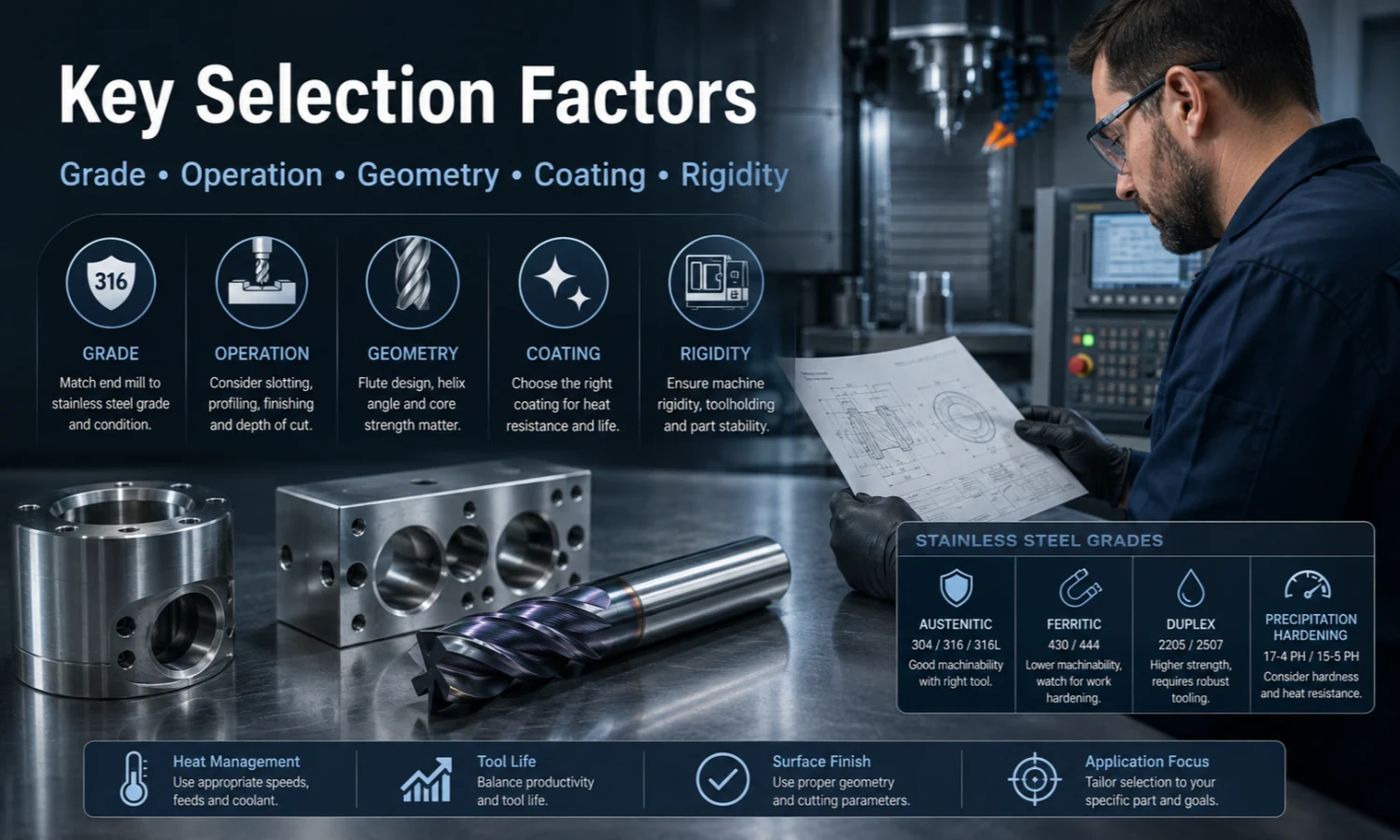
1. Stainless Steel Grade
Provide the exact grade whenever possible, such as 303, 304, 316, 17-4 PH, or another specified stainless alloy.
Describing the workpiece only as “stainless steel” may not provide enough information for accurate tool evaluation.
2. Machining Operation
Confirm whether the cutter will be used for slotting, side milling, profiling, roughing, finishing, pocketing, or 3D contouring.
3. Workpiece Geometry
Identify whether the feature is flat, curved, a shoulder, an R-corner, a deep cavity, or another internal or external contour.
This helps determine whether Flat, Ball Nose, Corner Radius, or another cutter geometry should be considered.
4. Required Tool Dimensions
Useful dimensions include:
- Cutting diameter
- Flute length
- Overall length
- Shank diameter
- Corner radius, if required
For non-standard applications, a drawing is often more useful than a long written description.
5. Roughing or Finishing
A tool selected for efficient material removal may not be the same cutter used to produce the final surface finish.
6. Machine and Setup Rigidity
Machine condition, spindle, toolholder, tool overhang, workholding, and workpiece stability can all affect cutter performance.
A rigid carbide cutter cannot compensate for movement in the holder or workpiece.
7. Chip Evacuation
Chip evacuation becomes especially important in deep slots, pockets, enclosed machining areas, and operations with higher engagement.
Flute count should therefore be selected together with chip-removal requirements.
8. Surface Finish Requirement
A roughing operation and a final finishing pass may require different cutter designs even when machining the same stainless steel grade.
Frequently Asked Questions
What is the best end mill for stainless steel?
There is no single best end mill for every stainless steel application. Solid carbide is a common choice, but the final cutter should be selected according to the stainless steel grade, machining operation, workpiece geometry, flute count, coating, machine rigidity, chip evacuation, and required finish.
Will a solid carbide end mill cut stainless steel?
Yes. Solid carbide end mills are widely used for stainless steel machining because carbide provides high rigidity, wear resistance, and cutting-edge stability. The cutter geometry, coating, flute design, and machining conditions should still match the application.
How many flutes should I use for stainless steel?
It depends on the operation. Fewer flutes generally provide more chip space, while more flutes provide additional cutting edges and may improve rigidity or finishing performance under suitable conditions. Cutter diameter, engagement, chip volume, machining operation, and machine rigidity should all be considered.
What coating is best for stainless steel end mills?
There is no universal best coating. AlTiN, AlCrN, TiAlN, and other heat-resistant coating systems are commonly considered for stainless steel applications. The appropriate coating depends on the stainless steel grade, cutting temperature, cutter geometry, substrate, machining strategy, and coolant conditions.
Is a 4-flute or 5-flute end mill better for stainless steel?
Neither is automatically better.
For operations that create more chip volume, the additional flute space available in a 4-flute cutter compared with a similar 5-flute design may be useful. When radial engagement is controlled and chip evacuation is reliable, a 5-flute design may provide more cutting contacts.
The final choice still depends on cutter diameter, flute geometry, engagement, machine rigidity, and the specific operation.
Can the same end mill machine both 304 and 316 stainless steel?
A cutter may be suitable for both materials, but this does not mean the same machining conditions or cutter configuration will always be optimal. The complete application, including material behavior, geometry, tool engagement, heat generation, and machine setup, should be evaluated.
Need Help Choosing an End Mill for Stainless Steel?
For tool evaluation, please provide:
- Stainless steel grade
- Workpiece drawing
- Machining operation
- Required cutting diameter
- Flute length
- Overall length
- Shank diameter if specified
- Roughing or finishing requirement
- Corner radius or special geometry
- Any current machining problem or special requirement
Our factory can review the workpiece and machining requirements and help evaluate whether a flat end mill, ball nose end mill, corner radius end mill, roughing end mill, carbide end mill, or custom cutting tool is more appropriate for the application.
For non-standard requirements, the final cutter dimensions and geometry can be confirmed according to the drawing, workpiece material, and machining conditions.